I’m going to assume this is specifically a confrontation by an adult human determined to do harm to him or his friends on the surface, as opposed to an adult human falling Underground.
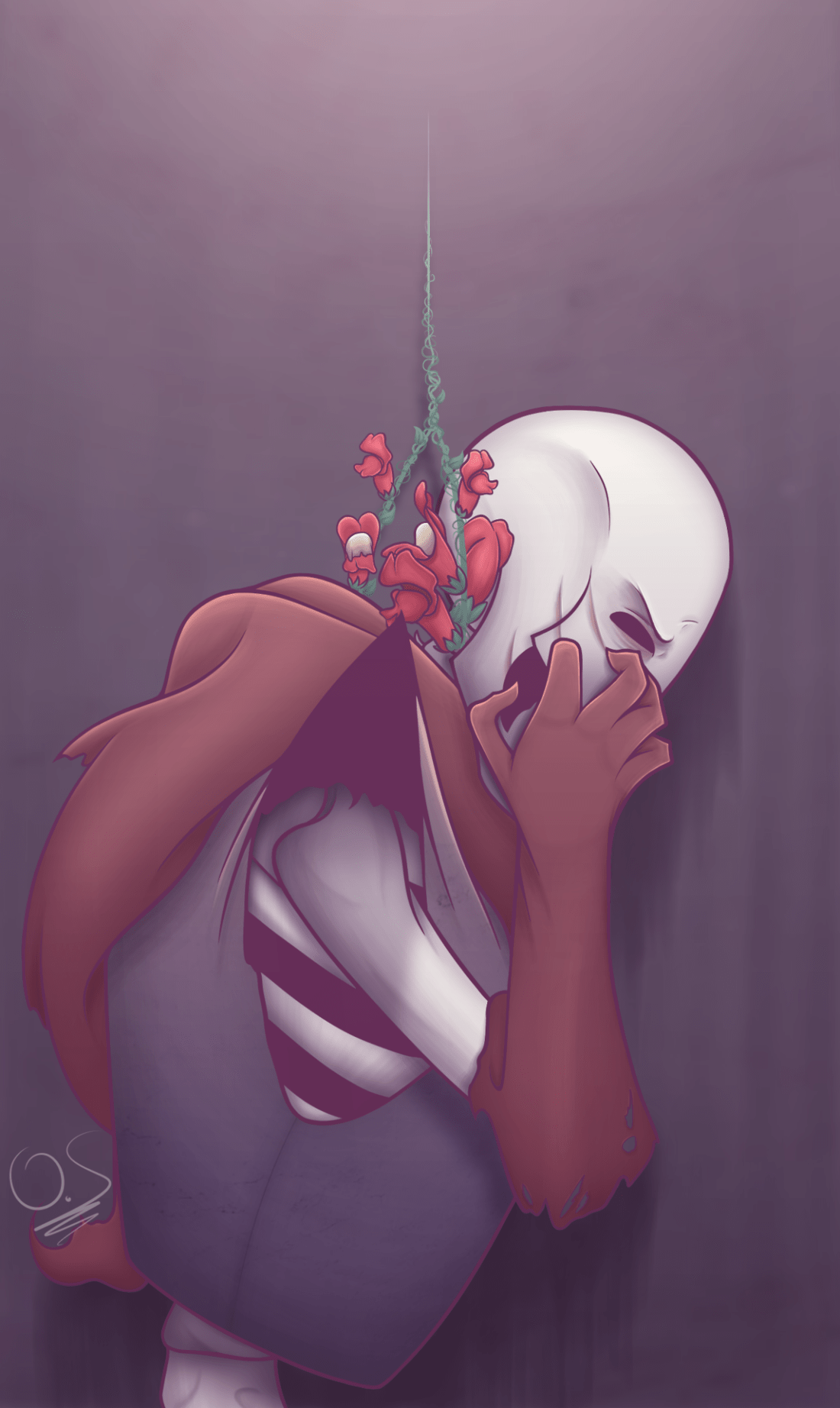
Thanks to the sweet anon who suggested UF paps! Tried a bit more of a symbolic approach to the hanahaki disease with Edge, with the flowers from @tyranttortoise once again. Also, fun fact, when a snapdragon dries up the seed pod looks like a tiny skull.
My gods, this is gorgeous. I’ve stared at this for so long, and everything about it from the colors, to the pose, to the sheer emotion in it is nothing short of amazing.
I also like the thought behind the flower noose. I feel like the flower–and the feelings it represents–are suffocating. And it’s a different kind of suffocating than what Stretch experienced when he couldn’t stop retching up flowers.
Stretch’s flowers were like… his feelings that he wanted to keep hidden, for the good of the human and his bro–but they kept coming to the surface and simultaneously burrowing deeper within him.
While Edge here… is being strangled by his own feelings because of his own inaction. And the more he refuses to address them, to pretend they’re not there and things are fine remaining the same, the tighter the flower noose becomes.
I love this. ❤
I would love to see more authors and artists taking advantage of Hanahaki disease. This is an intensely emotional piece, and I love the implications behind it.
In order to successfully write horror, you must first understand fear. Fortunately, fear is a universal experience, and likely something you have intimate first-hand knowledge of – the key is learning to harness your fears so they can be translated for the page.
First, recognize that different techniques and approaches will work better in different media. What works well in a horror movie may not translate well to a written story, and vice versa. Understanding your medium and your goals will help you work to the strengths of the medium and provide the most effective approach.
Second, remember that horror, perhaps more than any other genre, is at its core interactive. Even a linear story told through writing or visual cues invites participation from the reader: You need them to engage so that they will bring their own fears to the table. Simply seeing characters interact with frightening things isn’t enough; you need to invoke fear in the reader by inviting them to experience the things that you describe. That’s something I’ll delve into in greater detail in a later post, but for now, keep it in the back of your mind.
Two Main Types of Horror
There are two primary types of horror reactions you can create in a reader: Visceral horror, and cerebral horror.
Visceral horror is felt in the gut. It preys upon the lizard brain and taps into basic primal fears. Visceral emotions include disgust and shock. It is most effective in visual media, where a viewer sees images and responds to them before their brain has a chance to process them, but you can still invoke these feelings through the careful use of description. More on that in a minute.
Cerebral horror is felt in the brain. It’s the type of horror that you think about hours or days or years later, the kind of disturbing ideas that implant themselves in there and become more frightening the more you consider them. These are rooted in anxiety rather than the primal lizard brain. Cerebral horror includes fridge horror and dread. A tightly crafted story will beat a movie every time when it comes to cerebral horror, because written media is more intimate. Use that to your advantage.
The Emotions of Horror Stories
Let’s talk in a little more detail about the emotions that you should work to create in your reader when crafting a horror story. In order of most-difficult to most-natural for the written medium, try experimenting with:
Shock: Films and video games can fall back on the “jump scare,” a tactic wherein you rapidly break suspense with a sudden visual cue, almost always accompanied by a loud noise. If you need an example for some reason, turn to the nearest Five Nights At Freddy’s game.
Jump scares work by temporarily startling the viewer, short-circuiting their conscious brains and tapping directly into their oldest and most primal reflex. Newborns startle when they are exposed to too much sensory input – it’s literally their first line of defense. When you jerk, scream, or flail, you are tapping in to the newborn infant part of your brain.
Can you do a jump scare in a novel? Probably not. For one, there is no sound, and sound is extremely important to a successful jump scare. For another, reading involves conscious interaction with text; you can’t really bypass their thought processes enough to invoke a jump scare response (except for the occasionally really susceptible reader).
But you can still shock them, and that’s just as good.
Shock occurs when a reader is totally blind-sided by new information. They think they know what’s going on, but in reality, the truth is something unexpected (and perhaps far more sinister). They think a certain character is safe, only for them to be suddenly and brutally murdered. They think they’ve solved the puzzle, but the rabbit hole actually goes much deeper. I’ll talk about shock in greater length in another post, because it is so difficult to do well and requires a lot more attention.
Disgust: Gore and “splatterpunk” relies on the visceral response of disgust. We are naturally repulsed by certain things, and that too may be hardwired into our DNA (although it’s also partly based on nurture and cultural factors). But basically, disgust exists to keep us away from things that may hurt us, like diseased things.
Triggering disgust in your reader will mostly fall to writing effective descriptions. Word choice matters a lot when it comes to writing gore. Some words just feel gross (think “moist”), and some invoke really icky mental images. I’ll write a whole thing on tricks to writing gore at a future point, but for now a word of caution: Horror cannot rely on gross-out scenes alone. You might invoke a kind of sick fascination in the reader, but you won’t really scare them.
Dread: Suspense and dread are vital ingredients to horror in any medium. They work by drawing the reader into the story, enticing them to think ahead – but stripping away their certainty about what will happen. A really good story will alternate between shock and dread, building up tension before twisting the narrative in an unexpected direction.
I wrote a little bit about invoking dread here, and I’ll delve into the topic at greater length later. But for now, remember: Suspense lies in giving the reader the pieces to a puzzle, but withholding context. It forces the reader to think ahead, to try and make sense of what they’re seeing, and to imagine terrible conclusions. It encourages the reader to think “what if…?” or “something terrible is going to happen but when? how? what?”
This is something you can only do well if the reader is invested in the characters and truly cares about them. Fortunately, because writing is so intimate, it’s easier to delve into a character’s mind and forge a strong connection between them and the reader.
Fridge horror: Fridge horror is basically when something becomes creepier or more disturbing the longer you think about it. It’s when the implications of something are more horrifying than what you see on the surface. It’s the part of the story the reader takes with them, the part that makes them question their own beliefs or world-view or even reality.
It is a cerebral horror, and it’s the thing that written stories can really excel at. I will – you guessed it – write a whole post on the topic in the near future, but until then, realize that fridge horror relies in part on logic (”oh god, this means THAT!”) and part empathy (”can you imagine what it must be like….?”)
The best fridge horror moments will be pulled from your own personal experiences and fears. While anyone can tap into primal fears (the dark, the unknown, disgusting things), fridge horror is often deeply personal and oddly specific. It’s raising a question and leading the reader to think “Oh god, I never thought of that, but it is terrible.”
I’ve rambled on a long time now, and I have many things to come back to and explain in more detail – but for now, hopefully this gives you something to think about! Until next time, stay scared 🙂
If you like this type of content and would like to see more, please consider leaving a tip in my Tip Jar!
👎🏼 Very simple 👍🏼 Basic 👎🏼 Very shy 👍🏼 Timid 👎🏼 Very short 👍🏼 Brief 👎🏼 Very shiny 👍🏼 Gleaming 👎🏼 Very sharp 👍🏼 Keen 👎🏼 Very serious 👍🏼 Grave 👎🏼 Very scary 👍🏼 Chilling 👎🏼 Very scared 👍🏼 Petrified 👎🏼 Very sad 👍🏼 Sorrowful 👎🏼 Very rich 👍🏼 Wealthy 👎🏼 Very rainy 👍🏼 Pouring 👎🏼 Very quiet 👍🏼 Hushed 👎🏼 Very quick 👍🏼 Rapid 👎🏼 Very pretty 👍🏼 Beautiful 👎🏼 Very powerful 👍🏼 Compelling 👎🏼 Very poor 👍🏼 Destitute 👎🏼 Very perfect 👍🏼 Flawless 👎🏼 Very pale 👍🏼 Ashen 👎🏼 Very painful 👍🏼 Excruciating 👎🏼 Very open 👍🏼 Transparent 👎🏼 Very old-fashioned 👍🏼 Archaic 👎🏼 Very old 👍🏼 Ancient 👎🏼 Very often 👍🏼 Frequently 👎🏼 Very noisy 👍🏼Deafening
1. Write 500 words (or 30 minutes) every day. This tip can be awesome for making writing a ‘habit.’ I know that! Yet recently, usually at 12:00am, I end up thinking, “JUST ONE SENTENCE! PLEASE! ONE SENTENCE AND YOU CAN TICK THE ‘DAILY WRITING’ BOX!”
2. Make an outline. An outline ensures that every scene drives your story forwards. Man, my editing phase would be so much quicker if I could just follow this rule! But if you know the whole story… isn’t it a bit boring? I think the not knowing is what motivates me to write! (Please someone, find me a counter-argument!)
3. The best way to say something is often the simplest one. Artist!Aly: “But wouldn’t it sound so much more interesting/beautiful/rhythmic/revolutionary if I wrote it like… or maybe… or if I just remove these few words… nope, the simplest it is!”
4. Do not write and edit simultaneously. Finish writing first. Editing is a separate process. My inner perfectionist despises this rule. Oh yeah, it’s personal. Every time I finish a paragraph and avoid critiquing it, I feel an unnatural tension take over, and hear a small voice shout, “you’ll never be a writer!”
5. If your goal is to finish your novel, find a new goal. It leads to better mental health to think of writing as a journey, rather than a task to be completed. If you aim for the end goal, you will probably panic and catastrophise every obstacle. So I tell myself, “Aly, you don’t actually want to finish your novel. You only really want to write whatever you can reasonably achieve in the next 30 minutes.” Sigh. My life would be so peaceful if I managed to believe that shit.
catch of breath, choke, gulp, heave, inhale, pant, puff, snort, wheeze, huff, rasp, sharp intake of air, short of breath, struggle for breath, swallow, winded
 Dragon Blog